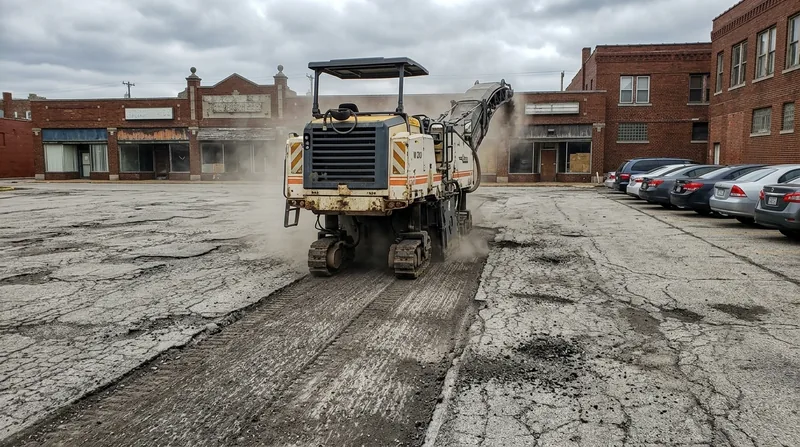




Asphalt Milling & Removal in St. Louis is the first step when old pavement hides a foundation that has already failed. St. Louis sits on expansive clay and loess that swells when wet and shrinks when dry, moving the ground beneath driveways and parking lots through every season. Over time, this movement breaks the base layer into fragments. A new surface laid over broken base fails within months. We mill down to sound material, haul off the debris, and grade the base so the new surface ties in flush with existing pavement and lasts.
Why Milling Matters in St. Louis: The Clay Problem Below
The St. Louis region experiences more than a hundred freeze-thaw cycles every winter, and wet springs saturate the clay before hot summers dry it out again. That cycle cracks and heaves asphalt from below long before the surface shows wear. When you see alligator cracking across a driveway or a pothole that returns after a patch, the base has usually already moved or broken apart. Simply laying new asphalt over that compromised foundation wastes money, because the ground will move it again. Milling removes the failed material down to the point where the base is still sound, and grading re-establishes a stable platform.
- We identify how deep the failure goes by examining the pavement edge and testing the base layer.
- Milling removes asphalt in horizontal passes, grinding it into recyclable chips as we go.
- The milled surface is then graded and compacted so it slopes for drainage and sits level with adjoining pavement.
- A new asphalt layer is applied to a foundation that will not move again this season or next.
This approach is especially common in older neighborhoods where dense brick stock and narrow rear driveways sit on clay that has been moving for a hundred years, and in suburban subdivisions where post-war development left lighter base preparation than modern standards require.
Key info: A driveway in Ferguson or Florissant that shows alligator cracking over most of its surface has a failed base. Patching will not hold. Milling and overlay addresses the root cause and gives you a durable surface for the next decade.
For guidance on whether your specific driveway needs milling or can be resurfaced, see our page on Asphalt Resurfacing & Overlay.
How We Mill and Remove Asphalt in St. Louis: The Process Step by Step
Milling is a controlled grinding operation that requires precision equipment and a clear understanding of what lies beneath. We start by locating utilities (Missouri 811 locates are required by law before any excavation), then measure the depth we need to mill based on the condition of the base. The mill grinds the asphalt into chips, which we collect and haul away for recycling or reuse. Once the base is exposed, we grade it, proof-roll it to confirm stability, and prepare it for new asphalt.
- We call 811 to mark utilities and confirm there are no surprises underground.
- The mill is positioned and set to the depth we need, grinding the asphalt as it moves across the surface.
- We haul off milled material immediately, keeping the site clear and safe.
- The exposed base is graded and compacted, with water added to lock in density.
- Proof rolling confirms the base will not move under load before we pave.
- New asphalt is applied in lifts, compacted while hot, and finished flush with the existing edge.
The whole operation typically takes one to three days depending on the area and the depth of milling required.
Local example: A 2,500-square-foot driveway in Webster Groves that has settled unevenly and shows cracking across thirty percent of its surface usually needs milling to one to two inches, depending on whether the base failure is shallow or deep. We grade and compact the base, then lay a new two-inch wearing course. The entire process takes about two days.
Learn more about the costs and decisions involved in Driveway Replacement.
Milling Methods: Full-Depth Removal, Partial Milling, and Recycling
| Approach | Description | Best for |
|---|---|---|
| Partial Milling (1-2 inches) | Remove only the top wearing course, leaving the base intact if it is still sound. Milled chips are hauled away or recycled on-site. | Driveways with minor cracking and a stable base; resurfacing without full replacement. |
| Full-Depth Removal (4-6 inches) | Mill the entire asphalt section down to the base layer, exposing soil or aggregate for re-grading and compaction. | Driveways with failed bases, severe alligator cracking, or settlement; parking lots with extensive damage. |
| Milling with RAP Reuse | Milled asphalt is crushed and mixed into the new base layer or used as recycled asphalt millings for gravel drives. | Cost-conscious projects; gravel driveway upgrades; sites where material can remain on-property. |
| Milling and Haul-Off | Milled material is removed from the site entirely and taken to a recycling facility or aggregate processor. | Urban properties where space is limited; HOA requirements for clean removal; when reuse on-site is not practical. |
Each approach has a different cost and timeline. We assess your base condition on-site and recommend the method that gives you the longest-lasting surface for your budget.
Asphalt Milling & Removal Cost in St. Louis: What to Expect
Milling costs depend on the depth of removal, the size of the area, and whether the milled material is hauled away or recycled on-site. A typical residential driveway milling starts at $1,500 to $3,000 for partial milling of a 2,000-to-2,500-square-foot area. Full-depth removal runs higher because it requires more equipment time and often involves base grading and compaction. Parking lots and larger commercial jobs are quoted on-site based on square footage and the depth of material to be removed.
- Partial milling (one to two inches) of a standard residential driveway costs less than full-depth work because less material is removed.
- Full-depth removal includes base preparation, grading, and proof rolling, which add time and equipment cost.
- Milled material that is hauled away costs more than material that is recycled on-site or left for reuse.
- Access and site conditions matter. A tight alley in the city grid costs more per square foot than a suburban lot with room for equipment.
- We provide a written estimate that includes tonnage, depth, and the full scope of work so you know exactly what you are paying for.
For a detailed pricing breakdown and to understand how your specific situation affects cost, visit our Pricing page or call us at (314) 916-3751 for a free estimate.
Asphalt Milling & Removal Near Me: What St. Louis Homeowners Should Know
When you are looking for a contractor to mill and remove asphalt, verify that they understand the local clay and freeze-thaw cycle that drives failure in St. Louis. A contractor who simply patches or overlays without assessing the base is setting you up for the same problem in two or three years. Ask for a site visit and a written estimate that explains how deep they are milling, why, and what the base condition is. Check references, especially from properties in your neighborhood where conditions are similar.
- Verify that the contractor is fully insured and can provide a certificate of insurance upon request.
- Ask for a written estimate with tonnage, depth of milling, and a description of base condition before and after.
- Request references from similar jobs in St. Louis, Kirkwood, Clayton, or Chesterfield where clay movement is a known issue.
- Check whether your city requires a permit for the work. St. Louis City and most St. Louis County municipalities require permits for driveway aprons and curb cuts; milling and removal may trigger permitting requirements depending on the scope.
- If your property is in an HOA, confirm that the milling and new asphalt comply with architectural standards before work begins.
Avoid contractors who show up unsolicited, offer a price without a site visit, demand a large cash deposit, or have out-of-state plates. The itinerant "leftover asphalt" pitch is a historic fraud in this trade. We are a local shop with a local address, in business since 2013, and we stand behind our work with a one-year workmanship warranty.
Contact us for a free estimate at our contact page or call (314) 916-3751. We will visit your property, assess the base, and give you a clear recommendation on whether milling, resurfacing, or replacement makes the most sense for your budget and timeline.
Asphalt Milling & Removal in St. Louis: Pricing Guide
| Service | Price | Details |
|---|---|---|
| Partial Milling (1-2 inches), 2,000-2,500 sq ft residential driveway | Starting at $1,500 | Includes milling, haul-off of material, base grading, and compaction. Larger driveways or deeper removal cost more per square foot |
| Full-Depth Removal (4-6 inches), 2,000-2,500 sq ft residential driveway | Starting at $2,500 | Includes complete removal, base exposure, grading, proof rolling, and compaction. Extensive base work increases cost significantly |
| Parking Lot or Commercial Milling | On estimate | Square footage, depth, access, and whether material is hauled or recycled on-site determine the final price. Site visit required |
| Milling with Material Recycling (RAP reuse on-site) | Starting at $1,200 | Milled asphalt is processed and used as base material or for gravel drive upgrade. Saves haul-off cost, reduces material waste |
| Free Estimate | No charge | Site visit, written estimate with tonnage and depth specifications, and recommendation on milling versus overlay. Response within 24 hours |
Indicative pricing, the exact cost depends on square footage, finish, and site access. Free personalized estimate within 24h at (314) 916-3751.


