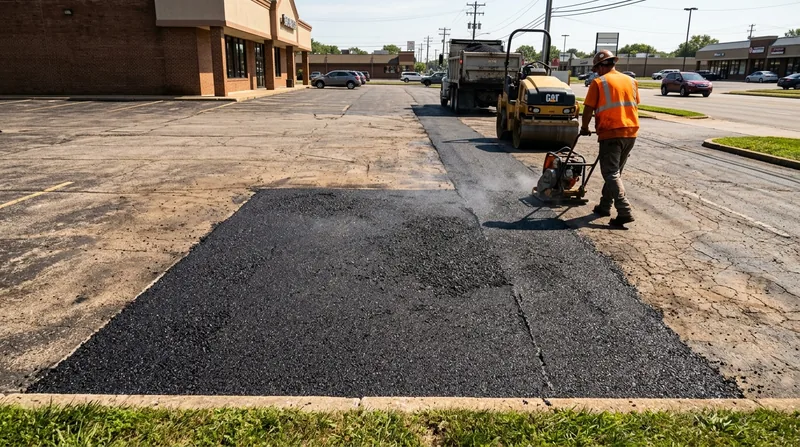




St. Louis parking lots face a distinct challenge: the expansive clay beneath them swells when saturated in spring and shrinks as it dries in summer, and a typical winter delivers over a hundred freeze-thaw cycles that crack and fracture asphalt from below. A St. Louis parking lot that breaks apart after a wet winter is usually failing from the base up, not from wear on the surface. Parking lot repair and resurfacing in St. Louis means cutting out the failed section, rebuilding the aggregate base to shed water properly, and patching it flush so it holds through the next season. We've been doing this work since 2013, and we know exactly what the St. Louis climate does to asphalt that sits on poor base preparation. If your lot is cracking, potholes are forming, or the surface is buckling and heaving, we can diagnose what's failed and propose the right fix, whether that's a targeted patch or a full resurfacing of the whole lot.
Why Parking Lot Repair Matters in St. Louis: The Clay and the Freeze-Thaw Cycle
St. Louis sits on expansive clay and loess that moves with water content, and our continental climate pushes freeze-thaw cycles through the pavement more than a hundred times every winter. When that clay swells and shrinks, it lifts and settles the asphalt above it, breaking the bond between the surface and the base. Water works into those cracks, saturates the base layer, and when temperatures drop below freezing, that moisture expands and heaves the pavement from underneath. By spring, what looked like surface cracking is actually a base failure, and patching just the top will fail within a year because the ground is still moving.
- Alligator cracking across a section of the lot signals base failure and requires full-depth repair, not just a surface seal.
- Potholes that return after patching mean the base is compromised and water is still entering from below.
- Heaving and buckling at the edges or in the middle of the lot show that the clay is pushing up, and the asphalt has lost its anchor.
- Standing water or poor drainage on the lot accelerates base failure because it keeps the clay saturated through the season.
Catching these failures early and cutting out the damaged section prevents the failure from spreading to the rest of the lot and saves money in the long run.
Key info: In Chesterfield, Kirkwood, and other suburbs where lots sit on newer fill and poor base prep, we regularly find that parking lot failures that look like surface wear are actually base problems. That's why we always look at the base and drainage before we quote a repair.
For more information on how base preparation affects all asphalt surfaces, see our guide to asphalt resurfacing and overlay, which covers the difference between patching and full reconstruction.
How We Repair and Resurface Parking Lots in St. Louis
Our process starts with a walk-through of the lot to map the failed areas, check the drainage, and probe the base to see how deep the damage goes. We measure the affected sections and take core samples if needed to confirm base integrity. From there, we can propose a targeted patch for localized failures or a full resurfacing if the damage is widespread. For a typical parking lot in Webster Groves or Ferguson, a partial repair takes one to two days, while a full resurface of a medium lot runs three to five days depending on size and traffic needs.
- We saw-cut the perimeter of the failed section to create clean, straight edges for the patch.
- We remove the failed asphalt and underlying base material down to stable ground.
- We compact and proof-roll the subgrade to confirm it will not settle further.
- We place new aggregate base in lifts, compact each lift, and check the slope for drainage.
- We set a tack coat to bond the new asphalt to the existing pavement around the patch.
- We place and compact new hot mix asphalt flush with the surrounding lot surface.
The patch is ready for light traffic in hours and full traffic within 24 hours, depending on air temperature.
Real example: A commercial lot in Clayton had six potholes and alligator cracking over about 40 percent of the surface. The base was gone in those areas. We removed and replaced the base, resurfaced the entire lot, and the owner gained another 10 years of pavement life. A patch-only approach would have failed within a season.
Learn more about the full range of parking lot paving and construction options, or read about our asphalt milling and removal process for lots that need complete reconstruction.
Parking Lot Repair Methods: Patch, Overlay, or Full Replacement
| Approach | Description | Best for |
|---|---|---|
| Full-Depth Patch | Remove failed asphalt and base, rebuild the base to proper compaction and slope, place new asphalt flush with existing surface. | Localized failures, potholes, alligator cracking in one or two sections, base failures under 20 percent of lot. |
| Asphalt Overlay | Mill the top layer of existing asphalt, reset the grade and drainage, place new hot mix asphalt over the existing base. | Surface wear and cracking, the base is sound, the lot has minor settling, you want to raise the elevation. |
| Full Reconstruction | Mill and remove all existing asphalt, excavate and rebuild the base, place new asphalt on a proper foundation. | Extensive base failure, widespread alligator cracking over 40 percent or more of lot, poor drainage, settlement or heaving. |
| Spot Repair and Sealant | Fill individual potholes with cold patch or hot mix, seal cracks with sealant material to prevent water infiltration. | Temporary fixes, budget constraints, lots in early stages of cracking before base failure occurs. |
The right method depends on how much of the lot has failed and whether the base is sound. We recommend full-depth patching when failures are localized and the base is intact, and resurfacing or reconstruction when damage is widespread or the base has lost compaction.
Parking Lot Repair and Resurfacing Cost in St. Louis: What to Expect
Parking lot repair and resurfacing costs depend on the size of the lot, the extent of the damage, and whether you need base work or just a surface fix. A small pothole repair or spot patch starts around $650 to $1,200 for a localized area. A full-depth patch covering 500 to 1,000 square feet of failed section runs $2,500 to $5,000 depending on base depth and compaction needs. A full resurfacing of a medium commercial lot (5,000 to 10,000 square feet) typically falls in the $8,000 to $18,000 range, while larger lots or those requiring complete base reconstruction can exceed $25,000.
The biggest cost driver is the extent of base failure. If the base is sound and you only need a surface overlay, the cost is lower. If the base is compromised and you need to excavate, compact new base material, and place new asphalt, the cost rises. Drainage problems, standing water, and poor site access also increase the price because they add time and equipment needs.
We always provide a written estimate with tonnage specs and a breakdown of labor, materials, and base prep so you know exactly what you are paying for. A free estimate is the right place to start, and we recommend getting two or three quotes so you can compare scope and pricing. Visit our pricing page for more detail on what different lot sizes and repair types cost in the St. Louis market.
What to Look for When Hiring a Parking Lot Paving Contractor Near St. Louis
A good parking lot contractor is local, carries insurance, and gives you a detailed written estimate before the work starts. Verify that any contractor you hire is fully insured, ask to see a certificate of insurance, and check their references with property managers or business owners in your area. Local contractors have a reputation to protect and typically stay in the market for years, while itinerant crews that offer "leftover asphalt from a job nearby" and demand a large cash deposit are the hallmark of paving fraud. St. Louis has a strong local contractor base, and you should expect to work with someone who knows the city, the clay, and the freeze-thaw cycle.
Ask your contractor whether they will pull permits if your municipality requires them. Permitting rules vary from city to city across St. Louis County and the surrounding counties, and some jurisdictions require a permit for parking lot work while others do not. The City of St. Louis, Clayton, Kirkwood, Chesterfield, and other municipalities all have different rules, so verify with your local building department or HOA before you sign a contract. A contractor who helps you navigate permitting and explains the local rules is one you can trust.
Get your estimate in writing with a clear description of the scope, the materials, the base preparation work, and the tonnage of asphalt being placed. A per-square-foot price without tonnage is a red flag because it does not tell you whether the base is being rebuilt or just the surface patched. We provide all estimates with tonnage specs and a breakdown of the work so there are no surprises.
Contact us at (314) 916-3751 for a free estimate or visit our site to schedule a walk-through of your lot. We have been serving St. Louis since 2013 and we know the local terrain, the climate, and the right way to build a parking lot that holds.
Parking Lot Repair & Resurfacing in St. Louis: Pricing Guide
| Service | Price | Details |
|---|---|---|
| Spot Pothole Repair | Starting at $650 | Single pothole or small localized failure, no base work required, ready for traffic same day |
| Full-Depth Patch (500-1,000 sq ft) | Starting at $2,500 | Includes base excavation, compaction, new asphalt placement, cost increases with base depth and extent of failure |
| Lot Resurfacing (5,000-10,000 sq ft) | Starting at $8,000 | Overlay or light base work, drainage assessment, new asphalt, cost varies by lot size, base condition, and access |
| Full Reconstruction | On estimate | Complete base removal and replacement, extensive drainage work, or large lots require on-site measurement and soil assessment |
| Free Estimate | No charge | Written estimate with tonnage and scope breakdown, response within 24 hours, no obligation to proceed with work |
Indicative pricing, the exact cost depends on square footage, finish, and site access. Free personalized estimate within 24h at (314) 916-3751.


