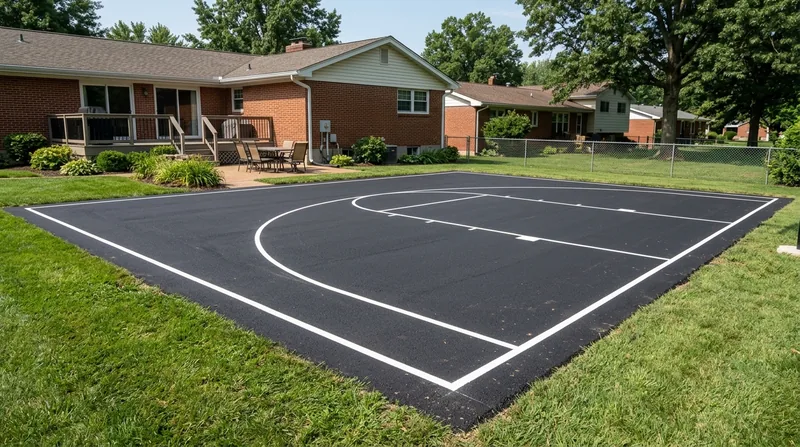




Sports Court & Path Paving in St. Louis demands a foundation that survives the region's relentless freeze-thaw cycles and the clay underneath that swells and shrinks through every season. A backyard basketball court, tennis court, or walking path built on unstable ground will crack, heave, and fracture within a year or two, no matter what surface sits on top. St. Louis sits on expansive clay and loess that moves constantly as moisture comes and goes, and winter pushes more than a hundred freeze-thaw crossings through the ground each year. A court that matters needs a properly graded and compacted base, hot mix asphalt or a coated surface laid right, and drainage that keeps water from pooling underneath. We build courts and paths that stay flat and usable through decades of St. Louis weather, not just one season.
Why Sports Court & Path Paving Matters in St. Louis: Ground Movement and the Freeze-Thaw Reality
St. Louis homeowners and property managers often discover that a new court or path cracks and heaves within the first winter, or settles unevenly by the second spring. The reason is the clay. Unlike stable sand or gravel regions, St. Louis sits on clay that absorbs water and expands, then dries and shrinks, moving whatever surface sits on top of it. Add a hundred freeze-thaw cycles each winter, and that movement becomes a force that breaks asphalt from below. A court or path paved over poor drainage or a thin, uncompacted base will fail fast. The fix is a stable, properly crowned base that sheds water away from the subgrade, set on compacted aggregate, then topped with hot mix or a sealed surface.
- We grade the site to shed water away from the court, preventing pooling and subsurface saturation that causes heaving.
- We compact the base layer in lifts to create a stable platform that resists the clay movement beneath it.
- We set hot mix asphalt or a coated recreational surface on top, sized and installed to handle the freeze-thaw stress.
- We design drainage around the court so water runs off quickly instead of sitting and breaking the base from below.
A court built this way will play true and stay usable through St. Louis winters without premature cracking or settlement.
Local example: A tennis court in Clayton or a basketball court in Webster Groves built on clay without proper base prep will heave and crack by the second winter. The same court, built on a compacted base with proper drainage, plays flat for decades.
The City of St. Louis and individual municipalities set permit requirements for impervious surfaces and drainage. Before you start, check with your local building department to understand what permits apply to your court or path. More detail is available through the driveway extension and site work pages, which cover similar base preparation and permitting issues.
How We Build a Court or Path That Stays Flat: The St. Louis Approach
Building a court or path starts with understanding what sits beneath it. We visit the site, look at the terrain, check drainage patterns, and assess the soil. St. Louis clay means we plan for movement, not against it. We grade the site to shed water, set a properly compacted aggregate base, proof-roll it to confirm stability, and then set the playing surface. Every step is measured and documented so you know what's underneath and why it will hold.
- We grade the court area to a slight crown or slope that sheds water away from the playing surface and the base below.
- We excavate and remove unsuitable soil, then compact a crushed stone or recycled asphalt base in layers.
- We proof-roll the base to confirm it will support the weight of the surface and foot traffic without settling.
- We set hot mix asphalt or a coated surface on top, finished smooth and level for play.
- We build edge restraint or curbing to keep the surface from spreading under lateral stress.
The result is a court or path that stays flat, drains properly, and survives the St. Louis climate year after year.
Real example: A residential basketball court in Kirkwood requires a 4 to 6 inch compacted base, a 2 to 3 inch asphalt playing surface, and drainage sloped away from the court. We grade, compact, and pave it so it plays true through winter freeze-thaw and summer heat. The same process works for walking paths, bocce courts, and pickleball courts.
Learn more about how we handle site grading and drainage on our gravel driveway and grading page, which covers the same base preparation principles.
Court and Path Paving Methods and Materials
| Approach | Description | Best for |
|---|---|---|
| Hot Mix Asphalt Court | Compacted stone base topped with 2 to 3 inches of hot mix asphalt, finished smooth and sealed after curing. | Basketball courts, tennis courts, and multipurpose recreational surfaces that need durability and fast play. |
| Coated Recreational Surface | Hot mix asphalt base coated with a colored, textured acrylic or polyurethane finish for sport-specific traction and appearance. | Courts where color, traction, and low maintenance matter, such as pickleball or sport-specific courts in subdivisions. |
| Gravel or Recycled Asphalt Path | Compacted recycled asphalt millings or gravel on a stone base, raked and crowned to shed water. | Walking paths, jogging trails, and informal recreational surfaces where a softer, lower-cost surface is acceptable. |
| Permeable or Pervious Asphalt | Open-graded hot mix asphalt that allows water to drain through the surface into the base, reducing runoff. | Municipalities and HOAs with stormwater limits, or properties where drainage and environmental compliance are priorities. |
Sports Court & Path Paving Cost in St. Louis: What to Expect
A backyard basketball or tennis court in St. Louis typically starts at $8,500 to $12,000, depending on size, base condition, and surface choice. A smaller walking path or pickleball court may cost less; a larger multipurpose court or one requiring extensive grading and drainage work will cost more. The biggest cost drivers are the size of the court (measured in square feet), the existing site condition (how much excavation and base work is needed), drainage requirements, and whether you choose hot mix asphalt or a coated recreational surface. A court on stable ground with good drainage will cost less than one on poor clay that needs significant base preparation. Getting two or three written estimates from local paving contractors is the smartest way to understand the true cost for your site.
Our pricing page covers the full range of our services and the factors that affect cost. We provide written estimates with tonnage and material specifications so you know exactly what you are getting.
Sports Court & Path Paving Near Me: What St. Louis Homeowners Should Know When Hiring a Contractor
Hiring a paving contractor for a court or path is a big decision, and getting it right means asking the right questions upfront. Start by verifying that any contractor you consider is fully insured, and ask to see proof of coverage. Check references from recent court and path projects in your area, and ask those homeowners whether the court stayed flat and drained properly through the first winter. Understand what permits your city or HOA requires, and make sure the contractor is willing to help you navigate the permitting process. Get a written estimate that includes the base depth, compaction method, surface thickness, and tonnage, not just a price per square foot. Avoid any contractor who shows up unsolicited at your door, quotes a price over the phone without visiting the site, or asks for a large cash deposit upfront.
- Ask any contractor for proof of full insurance coverage and the names of recent court or path projects you can contact.
- Check with your city or HOA to understand what permits are required for a court or path and whether architectural approval is needed.
- Request a written estimate that specifies base depth, compaction, surface material, thickness, and tonnage, not a price per square foot.
- Verify that the contractor understands St. Louis clay and freeze-thaw stress, and can explain how they will build a base that survives it.
- Ask whether the contractor offers a workmanship warranty, and get the terms in writing.
A local contractor with roots in St. Louis and a track record of courts and paths that have held through multiple winters is worth the conversation. Contact us for a free, no-obligation estimate and a conversation about what your site needs.
Sports Court & Path Paving in St. Louis: Pricing Guide
| Service | Price | Details |
|---|---|---|
| Small residential court (basketball or pickleball) | Starting at $8,500 | Includes base preparation, compaction, and hot mix asphalt surface for courts up to 1,500 square feet |
| Tennis court or larger multipurpose court | Starting at $12,000 | Includes excavation, compacted stone base, hot mix asphalt, and drainage for courts 2,000 to 3,000 square feet |
| Walking or jogging path (recycled asphalt or gravel) | Starting at $4,500 | Includes grading, compacted base, and recycled asphalt millings or gravel surface for paths up to 200 linear feet |
| Coated recreational surface (acrylic or polyurethane finish) | Starting at $14,000 | Hot mix asphalt base plus colored, textured coating for enhanced traction and appearance on courts up to 2,000 square feet |
| Complex site work or extensive grading | On estimate | Sites with poor drainage, unstable soil, or significant elevation change require on-site assessment before pricing |
| Estimate and site visit | Free | Written estimate with tonnage and material specs, no obligation, response within 24 hours at (314) 916-3751 |
Indicative pricing, the exact cost depends on square footage, finish, and site access. Free personalized estimate within 24h at (314) 916-3751.


