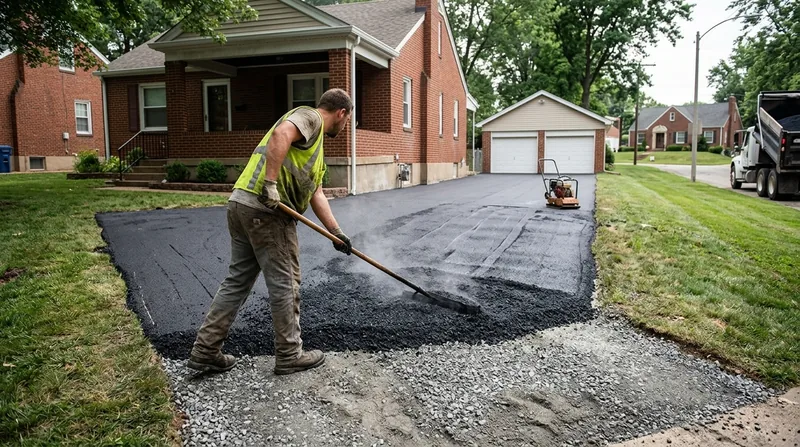




St. Louis driveways fail from the ground up. The clay and loess that lie beneath the city's brick neighborhoods and sprawling suburbs swell when wet and shrink when dry, moving the ground every season even in mild weather. Layer on top of that more than a hundred freeze-thaw cycles each winter, and the asphalt you installed ten or fifteen years ago begins to crack, heave, and separate from its base. When a driveway has shifted for years, patching and resurfacing stop working. That is when driveway replacement in St. Louis becomes the honest choice. We remove the failed surface, rebuild the aggregate base to handle the clay movement and spring saturation that dominate this region, and install new hot mix asphalt engineered for St. Louis winters. The result is a drive that stands up to what the climate and soil actually do here, year after year.
Why Driveway Replacement Matters in St. Louis: Understanding Ground Movement and Climate
A St. Louis driveway sits on expansive clay that behaves differently than the stable soils of other regions. When spring rains saturate the ground, the clay swells. When summer heat and autumn drought dry it out, it shrinks. That annual cycle moves the base beneath your asphalt, and the surface cracks, buckles, and separates. Add the freeze-thaw cycles of a typical St. Louis winter, where temperatures swing above and below freezing dozens of times, and the damage accelerates. Patching and resurfacing work when the damage is localized, but once the base has failed or the surface shows extensive alligator cracking across thirty to forty percent or more of the area, those repairs throw money away. Replacement removes the old surface, rebuilds the base with proper grading and drainage, and installs new asphalt set up to survive what happens in this climate.
- We remove the entire failed surface and expose the base layer beneath.
- We excavate, grade, and compact a new aggregate base designed to handle clay movement and spring water.
- We install new hot mix asphalt at the thickness required for residential traffic and St. Louis freeze-thaw cycles.
- We proof-roll the base to confirm proper compaction before the asphalt goes down.
A proper replacement lasts fifteen to twenty years in this market, and the investment pays back through reliability and avoided emergency repairs.
Key info: In Webster Groves, Kirkwood, and other inner-ring suburbs, many driveways built in the 1970s and 1980s now show the classic signs of base failure: alligator cracking, standing water after rain, and soft spots under the wheels. These are candidates for replacement, not repair. A free estimate will tell you whether your drive can be saved with resurfacing or needs to start over.
The City of St. Louis and surrounding municipalities have different rules about driveway aprons, curb cuts, and impervious surface limits. Some require a permit for replacement, others do not. Your local building department will tell you what applies to your address, and we help you navigate those requirements.
How We Handle Driveway Replacement: A Step-by-Step Process Built for St. Louis Conditions
Driveway replacement in St. Louis requires more than removing old asphalt and pouring new. The clay beneath moves, and if the base is not rebuilt correctly, the new surface will fail the same way the old one did. Our process starts with a careful site inspection, moves through proper base construction, and ends with new asphalt installed at the right thickness for this region's climate and traffic.
- We measure the driveway, note the slope and drainage, and identify any utilities before we begin work.
- We saw-cut the perimeter of the old surface and remove it with heavy equipment, hauling the debris off-site.
- We excavate and grade the subbase, removing soft or saturated clay and replacing it with compacted aggregate.
- We proof-roll the base with a heavy vibratory roller to ensure proper density and load-bearing capacity.
- We set the proper slope for drainage away from structures and toward the street or a drainage point.
- We lay new hot mix asphalt at three to four inches thick for residential driveways, compacted hot and rolled smooth.
The entire job typically takes two to four days depending on driveway size and weather. New asphalt must cure for a week before you drive on it regularly, and it will continue to harden for six to twelve months. Do not seal the new surface for the first year, as the asphalt is still curing and sealcoat applied too early can trap moisture and cause premature failure.
Example: A single-car driveway in Ferguson that was heaving and cracking required removal, base reconstruction, and replacement with new asphalt. The job took three days, and the base work cost more than half the total because the clay beneath had already failed. A written estimate with tonnage and thickness specifications made clear what the money was buying.
If your driveway is still sound in most places but has failed in one or two areas, driveway repair or patching may be the better choice. We assess every drive honestly and propose replacement only when repair will not hold.
Methods and Approaches
| Approach | Description | Best For |
|---|---|---|
| Full-Depth Replacement | Remove old surface and base, rebuild with compacted aggregate, install new hot mix at proper thickness. | Driveways with failed base, extensive alligator cracking, or heaving from clay movement. |
| Removal and Recycling | Remove old asphalt and haul to recycling facility, leaving the base for new installation or grading work. | When the base is still sound and you want to lower cost by handling grading separately. |
| Base Repair and Replacement | Excavate and replace failed or soft base material with compacted aggregate, then install new asphalt. | Driveways where the surface is gone but base repair is possible without full excavation. |
| Milling and Overlay | Mill the top layer of old asphalt and install new overlay on the existing base. | Driveways where the base is still solid and the surface is worn but not failed. |
Replacement is the most expensive option because it addresses the root cause: a failed base. Resurfacing and overlay cost less but only work when the base is still good. A free estimate will clarify which approach makes sense for your driveway.
Driveway Replacement Cost in St. Louis: What to Expect
Driveway replacement in St. Louis starts at around seven dollars per square foot for a straightforward removal and installation on a sound base. A typical single-car driveway of 300 to 400 square feet runs between two thousand and three thousand dollars. That price moves up when the base requires significant work, when access is tight (as it often is in the dense neighborhoods of the city proper), or when the driveway is longer or wider than standard.
The biggest cost drivers are base preparation and the quality of the compaction work beneath the surface. In St. Louis, where clay movement is the dominant failure mode, a poorly built base will fail again in five to ten years. We quote by site measurement and tonnage specification, not by a flat per-square-foot rate, so you know exactly what material and labor you are paying for. See our full pricing overview for a range of typical jobs, and call (314) 916-3751 for a free estimate on your specific driveway.
Factors that affect the final cost include the size and slope of the driveway, the condition of the existing base, soil conditions and water drainage, access for equipment, and whether a permit is required by your municipality. A driveway in a tight alley in the city grid costs more to excavate and remove than a suburban drive on a wide lot. A driveway where the base has failed completely costs more than one where the base is still good but the surface is worn. Getting two or three estimates is the smart move, and each should include written tonnage and thickness specs so you can compare apples to apples.
What to Look for When Hiring a Driveway Replacement Contractor Near St. Louis
The asphalt paving trade attracts door-to-door crews with out-of-state plates who offer a price that sounds too good because they are planning to cut corners on base work or thickness. The honest contractor is local, has been in the area for years, and is willing to put a written estimate in your hand with tonnage and thickness clearly stated. Before you hire anyone for driveway replacement, verify a few things.
- Confirm the contractor is fully insured and ask to see a certificate of insurance covering liability and property damage.
- Get written estimates from at least two contractors and compare the tonnage, thickness, and base work, not just the bottom-line price.
- Ask for references from recent jobs in your area and follow up with a call or visit if you can.
- Verify that your municipality requires a permit for driveway replacement and that the contractor will help you navigate the permitting process.
- If you live in a master-planned community or an HOA, check the architectural standards and confirm that the contractor understands any material or design restrictions.
- Avoid any contractor who demands a large cash deposit upfront or who will not provide a written contract.
Licensing and permit requirements for paving contractors vary by municipality in the St. Louis area. The City of St. Louis has its own licensing rules, and St. Louis County municipalities each set their own. Before you hire, check with your local building department to understand what applies to your address. We are happy to help you navigate local permitting, and you can reach us at (314) 916-3751 for a free estimate and to answer any questions about the process.
Driveway Replacement in St. Louis: Pricing Guide
| Service | Price | Details |
|---|---|---|
| Single-car driveway replacement | Starting at $7/sq ft | 300 to 400 square feet with standard base work and two to three inch asphalt depth |
| Two-car or larger driveway replacement | Starting at $7/sq ft | 500 to 800 square feet, price may decrease per square foot as job size increases |
| Base repair or stabilization | On estimate | Excavation, grading, and compacted aggregate are measured on-site; clay conditions and depth determine final cost |
| Removal and hauling only | Starting at $1.50/sq ft | Old asphalt removed and recycled; base grading handled separately or by homeowner |
| Free estimate | No charge | Written estimate with tonnage and thickness specifications, response within 24 hours at (314) 916-3751 |
Indicative pricing, the exact cost depends on square footage, finish, and site access. Free personalized estimate within 24h at (314) 916-3751.


