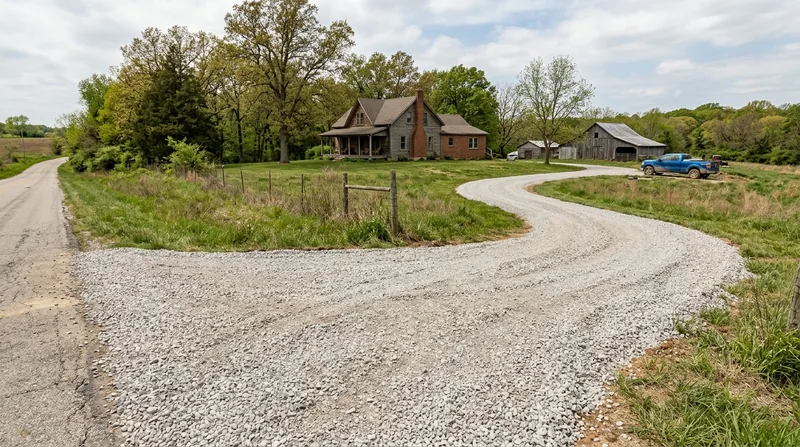




Out in St. Charles, O'Fallon, Wentzville and the western reaches of St. Louis County, gravel driveways still make sense on larger suburban and rural lots. But a gravel driveway installation and grading job done right requires real base preparation, not just dumping stone on clay. The expansive clay and loess that underlies the entire St. Louis region swells when it absorbs spring rain and shrinks when it dries through summer and fall, moving whatever sits on top of it. A gravel drive without proper grading becomes a mud pit in April and May, then washboards and ruts by July. We grade the base, lay crushed stone in layers, and shape it to shed water so it holds up through wet county seasons and the freeze-thaw cycles that crack unprepared ground every winter.
Why Proper Grading and Base Preparation Matter in St. Louis County
The clay foundation under most St. Louis County driveways is your biggest challenge. When spring rains saturate the soil, the clay expands and loses bearing capacity. Without a properly graded and compacted base, water pools under the gravel, turns the subgrade to mud, and the whole surface collapses into ruts and soft spots. We remove the topsoil, grade the clay base to slope away from the house for drainage, and compact it before laying crushed stone in layers. The stone itself provides drainage and distributes load across the weakened clay beneath.
- We remove topsoil and organic material that holds water and provides no bearing strength.
- We grade the subgrade to a minimum 2 percent slope away from structures so water sheds rather than pools.
- We compact the clay base with a mechanical roller to increase density and load capacity.
- We lay crushed stone in two or three layers, largest aggregate at the bottom for drainage, smaller stone on top for a stable walking and driving surface.
- We shape the final surface with a crown or slope so rain runs off and does not collect in the middle of the drive.
A properly prepared gravel driveway sheds water, resists rutting through heavy spring mud season, and holds up longer than a driveway built on unmoved clay.
Key info: In Chesterfield and Wildwood, where clay sits under newer suburban lots, we often encounter driveways installed without grading or base prep. After the first spring, the clay has moved and the gravel has settled into a washboard mess. Proper grading on the front end costs less than regrading and re-stoning every two years.
For permit requirements in your municipality, check with your local building department or HOA architectural standards. Some St. Louis County villages require a grading permit if the work involves fill or excavation; others do not. We help you navigate the permitting process for your specific location. For more on related preparation and site work, see our asphalt milling and removal service, which covers similar grading and base-prep principles on existing paved surfaces.
How We Install and Grade Gravel Driveways in St. Louis
The process starts with a site visit and measurement. We assess the slope of the land, the condition of the existing soil, drainage patterns, and the size of the drive. We then provide a written estimate with tonnage specifications so you know exactly what material goes into the job and how much the work will cost. The installation itself follows a sequence that respects the clay and the water underneath.
- We mark the driveway boundaries and remove topsoil and vegetation to expose the native clay subgrade.
- We grade the subgrade to a consistent slope, typically 2 to 3 percent away from the house or building.
- We compact the clay base with a mechanical roller to increase bearing capacity and reduce settling.
- We lay the first layer of larger crushed stone, typically 3 to 4 inches of 1.5-inch aggregate, and compact it.
- We lay the second layer of smaller crushed stone, typically 2 to 3 inches of 0.75-inch aggregate, and compact it again.
- We finish with a top layer of marble chips, crusher dust, or recycled asphalt millings to create a firm, dust-controlled driving surface.
- We shape the entire surface to shed water toward the edges and away from any structures.
The whole job typically takes one to three days depending on the size of the drive and the condition of the existing ground. Once complete, the driveway is ready to use immediately, though we recommend avoiding heavy traffic for the first 48 hours while the base settles.
Example: A typical residential driveway in Wentzville or O'Fallon runs 12 to 16 feet wide and 40 to 60 feet long. After removing topsoil and grading the clay, we lay roughly 15 to 20 tons of crushed stone in layers, finish with 2 to 3 tons of marble chips or crusher dust, and shape the whole surface to slope away from the house. The job costs between $950 and $2,500 depending on existing conditions and material choices.
If your property is sloped or has drainage challenges, see our driveway extension and apron service, which handles site-specific grading and drainage solutions for problem lots.
Gravel Driveway Installation and Grading Methods
| Approach | Description | Best for |
|---|---|---|
| Full Base Prep with Crushed Stone Layers | Remove topsoil, grade and compact clay, lay 3 to 4 inches of large aggregate, 2 to 3 inches of smaller aggregate, finish with marble chips or crusher dust, and shape for drainage. | New driveways on clay soil, driveways that have settled or rutted, properties in flood-prone areas or with poor drainage. |
| Recycled Asphalt Millings Top Layer | Perform full base prep as above, but finish the top 1 to 2 inches with recycled asphalt millings instead of marble chips, which compacts and hardens over time as traffic binds it. | Budget-conscious homeowners, drives that will see moderate traffic, properties where a darker surface is acceptable. |
| Maintenance Grading and Stone Top-Up | Grade and re-crown an existing gravel drive, recompact the base, add fresh stone to fill ruts and washboards, and reshape the surface for drainage. | Existing gravel drives that have settled or rutted, seasonal maintenance before spring mud season, driveways that have lost crown or slope. |
| Transition to Asphalt or Tar and Chip | Prepare a gravel base with proper grading and compaction, then install a hot mix asphalt or tar and chip surface on top instead of loose stone. | Properties ready to upgrade from gravel, driveways that need a more durable or dust-free surface, high-traffic rural drives. |
Gravel Driveway Installation and Grading Cost in St. Louis: What to Expect
The cost of gravel driveway installation and grading depends on the size of the drive, the condition of the existing soil, the slope and drainage challenges of the property, and the material you choose for the top layer. A typical residential driveway with proper base preparation starts at $950 for a small drive on stable ground, and runs $1,500 to $2,500 for a larger suburban lot with clay that needs significant grading and compaction. Drives on steep slopes, in flood-prone areas, or with poor existing drainage may cost more because they require additional grading, swales, or culverts to manage water.
The largest cost driver is the volume of material and the labor to grade and compact the base. A 12-by-40-foot drive on level ground with stable clay may need 15 to 20 tons of stone and a day of labor. A 16-by-60-foot drive on a slope with saturated soil and poor drainage may need 25 to 35 tons of stone, additional grading, and two or three days of work. We provide a written estimate with tonnage specifications so you know exactly what goes into the job before we start.
We recommend getting estimates from two or three contractors so you can compare pricing and approach. A low estimate that skips base preparation or compaction is a red flag; the drive will settle and rut within a year. A high estimate that does not specify tonnage or methodology is also a warning sign. Our estimate includes the material, the labor, the equipment, and the grading work so you can make an informed decision. For a complete pricing overview and a free, no-obligation estimate, visit our pricing page or call us at (314) 916-3751.
What to Look for When Hiring a Gravel Driveway Contractor Near St. Louis
A reputable gravel driveway contractor in the St. Louis area should provide a written estimate with tonnage specifications, explain the grading and base-prep process, and answer questions about drainage and long-term maintenance. Verify that the contractor is fully insured, get references from recent jobs, and ask to see examples of completed driveways in your area or on similar soil types. Check your local building department and HOA to confirm whether a permit is required for grading or fill work on your property; some St. Louis County villages require a grading permit, and others do not, so requirements vary. The contractor should be able to explain the permitting process for your specific location.
Avoid contractors who offer unsolicited door-to-door quotes, demand a large cash deposit before starting work, or have out-of-state plates. These are classic signs of itinerant paving crews that move through neighborhoods and disappear if a problem arises. A local contractor with a local address, local phone number, and verifiable references is far less likely to cut corners or vanish after the job. Ask how long the contractor has been in business, whether they do the work themselves or subcontract it, and what happens if the drive settles or ruts within a year. A contractor who stands behind their work and offers a clear warranty or maintenance plan is a good sign.
We have been in business since 2013 and serve St. Louis, Clayton, University City, Webster Groves, Kirkwood, Florissant, Ferguson, Chesterfield, Ballwin, Wildwood, Maryland Heights, Creve Coeur, Affton, Oakville, Fenton, Arnold, St. Charles, St. Peters, O'Fallon, Wentzville, and surrounding areas. We provide written estimates with tonnage and material specifications, handle all grading and base preparation, and stand behind our work. For a free estimate and to discuss your specific property, contact us online or call (314) 916-3751.
Gravel Driveway Installation & Grading in St. Louis: Pricing Guide
| Service | Price | Details |
|---|---|---|
| Small residential gravel driveway with standard base prep | Starting at $950 | Includes topsoil removal, grading, compaction, and two layers of crushed stone on a 12-by-40-foot drive on level ground with stable clay |
| Medium residential driveway with full grading and finish stone | Starting at $1,500 | Includes base prep, compaction, multiple stone layers, marble chips or crusher dust finish on a 14-by-50-foot drive or larger suburban lot |
| Large or complex driveway with drainage, slope, or poor soil conditions | Starting at $2,200 | Includes extensive grading, compaction, swales or drainage work, multiple stone layers, and finish material on steep or flood-prone properties |
| Recycled asphalt millings as top layer instead of marble chips | Reduction of $200 to $400 | Saves cost on finish material; millings compact and harden over time with traffic, creating a darker, more stable surface |
| Maintenance regrading and stone top-up on existing gravel drive | Starting at $600 | Includes regrading, recompaction, and fresh stone to fill ruts and restore crown on drives that have settled or washboarded |
| Free estimate with written tonnage specifications | Free | Response within 24 hours at (314) 916-3751, no obligation to book, includes site assessment and material recommendations |
Indicative pricing, the exact cost depends on square footage, finish, and site access. Free personalized estimate within 24h at (314) 916-3751.


